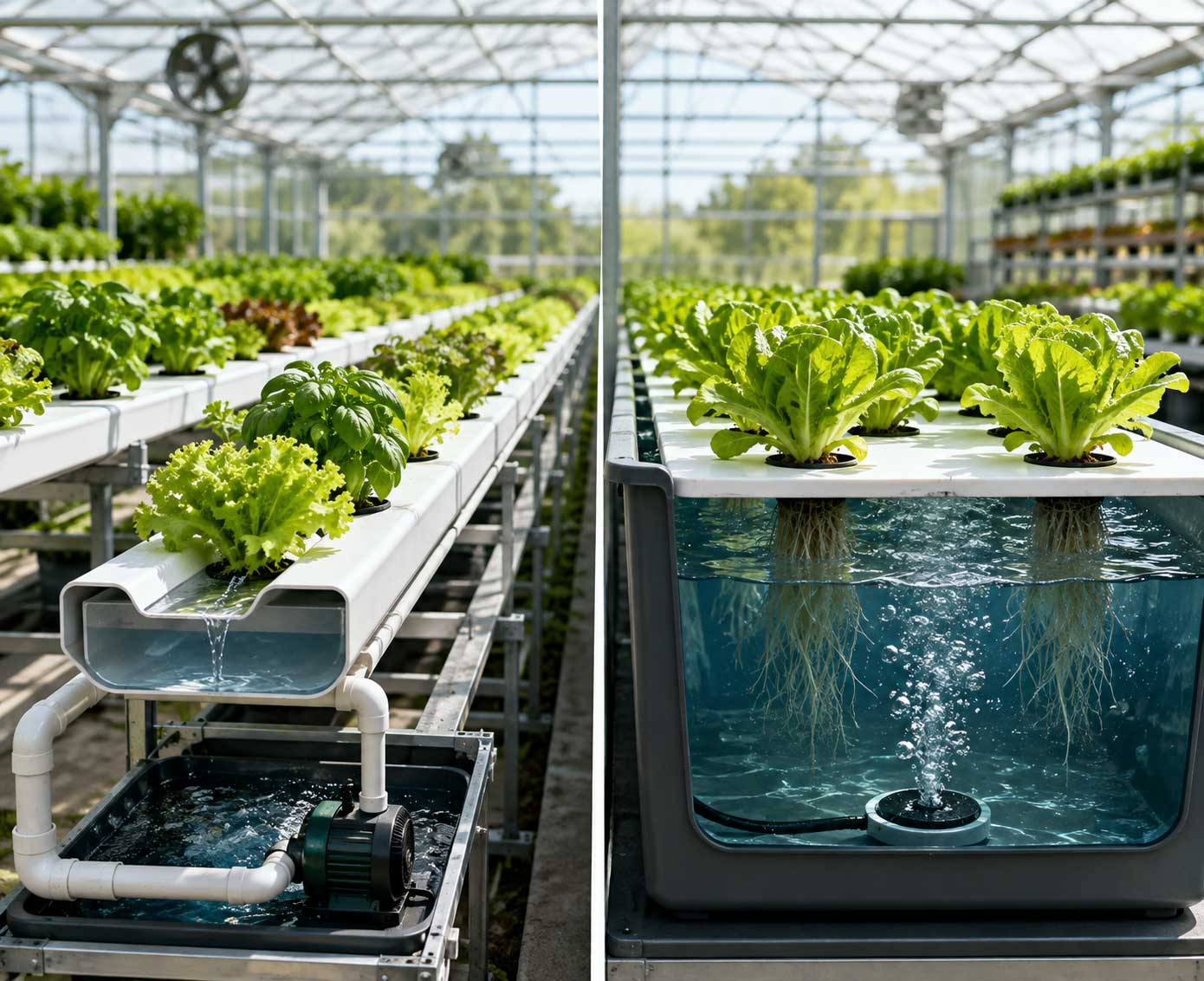
DWC vs RDWC hydroponic systems is an important comparison for growers who want to produce lettuce in a controlled, soil-free environment. Both systems keep plant roots in oxygenated nutrient solution, but they differ in water circulation, nutrient management, system complexity, and commercial scalability.
For commercial lettuce, the best choice is not always the most advanced system. A simple DWC setup can be easier and more cost-effective for leafy greens, while RDWC can provide stronger centralized control for modular growing projects. China JY provides DWC Hydroponic System, Hydroponic Supplies, and Greenhouse Supplies for growers, distributors, and greenhouse projects.
What Is a DWC Hydroponic System?
A DWC hydroponic system is a deep water culture system where plant roots grow directly into oxygenated nutrient solution. For lettuce, DWC is popular because lettuce has a short growth cycle, shallow root demand, and high water-use efficiency in controlled environments.
In a DWC system, plants are usually supported by net pots, rafts, lids, or grow boards, while roots hang into the nutrient solution below. Air pumps and air stones supply oxygen to the root zone. JY Grow Supply’s DWC system includes 20L buckets, net cups, nutrient pump, air hose, air stone, air flow adjustable valve, ring drip irrigation set, water level and drainage fitting, and main pipe accessories.
Hydroponics itself is defined by FAO as growing crops without soil by supplying minerals through a nutrient solution, which makes DWC a direct and easy-to-understand hydroponic method. For growers who need simple operation and stable lettuce production, DWC is often a practical starting point.
What Is an RDWC Hydroponic System?
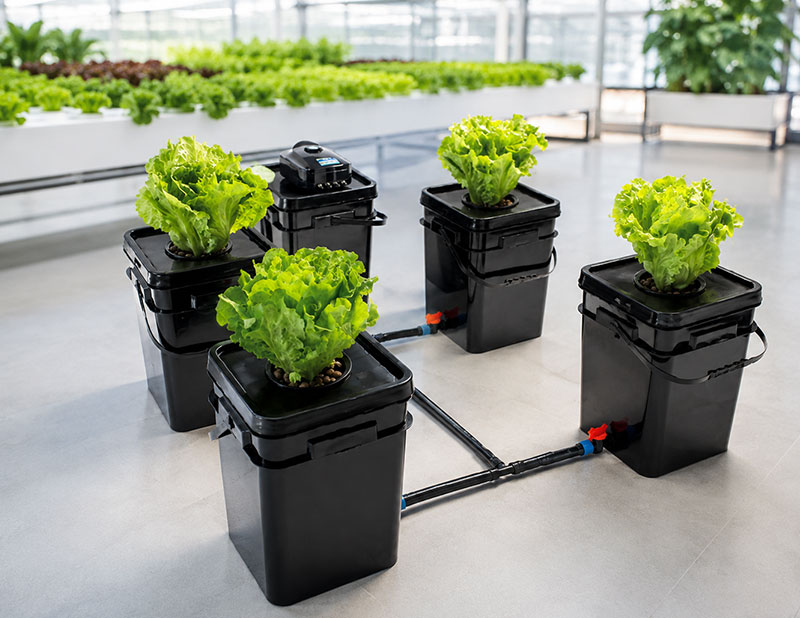
An RDWC hydroponic system is a recirculating deep water culture system where multiple grow buckets or containers are connected to a main reservoir and nutrient solution circulates through the system. Compared with standard DWC, RDWC allows growers to adjust water level, pH, EC, and nutrient concentration from a central tank.
China JY’s RDWC system includes 27L grow buckets, a main supply bucket, net cups, nutrient pump, air hose, clay pebbles, water level floating fitting, cycle and water pump, air stone, main pipe, shut-off valve, and optional water chiller. This structure is useful when growers want more centralized management and more consistent nutrient distribution across multiple grow sites.
For commercial lettuce, RDWC can reduce the labor needed to check every bucket separately. However, it also adds pumps, pipes, valves, and circulation management. If one disease or contamination issue enters the shared water loop, it may spread faster than in isolated DWC containers.
DWC vs RDWC for Lettuce: Comparison Table
DWC vs RDWC should be compared by lettuce density, water control, system cost, maintenance, scalability, and risk management. The table below helps buyers choose the right system for commercial lettuce.
| Comparison Item | DWC Hydroponic System | RDWC Hydroponic System |
|---|
| Basic Structure | Independent reservoir, bucket, raft, or container | Multiple grow buckets connected to one main reservoir |
| Water Movement | Mostly static, oxygenated by air pump | Recirculating nutrient solution with water pump |
| JY System Reference | 20L buckets with net cups and air stone | 27L grow buckets with main supply bucket and cycle pump |
| Lettuce Suitability | Strong for leafy lettuce and simple production | Good for modular projects needing centralized control |
| Management | Simple, but each unit may need checking | Centralized pH, EC, and water-level adjustment |
| Initial Cost | Lower | Higher due to pumps, pipes, fittings, and control |
| Failure Risk | More isolated; one unit failure is limited | Shared system can spread problems faster |
| Commercial Fit | Best for simple, dense, low-cost lettuce systems | Best for controlled modular systems and advanced growers |
For most commercial lettuce growers, DWC or floating raft-style deep water culture is often more efficient than bucket-based RDWC because lettuce needs high planting density. RDWC becomes more attractive when the project values centralized water control, automation, or modular system expansion.
Which System Is Better for Commercial Lettuce?
For commercial lettuce, DWC is usually better for simple, high-density, cost-sensitive production, while RDWC is better for growers who need centralized nutrient control and are willing to manage a more complex system. The right choice depends on greenhouse layout, labor cost, plant density, water management skill, and disease prevention strategy.
Lettuce production depends heavily on stable root-zone conditions. Oklahoma State University’s guide to electrical conductivity and pH in hydroponics notes that nutrient solution pH influences nutrient availability and is commonly managed around 5 to 6 for soilless culture. Cornell’s Hydroponic Lettuce Handbook also emphasizes parameters such as EC, pH, dissolved oxygen, water temperature, and controlled environment management.
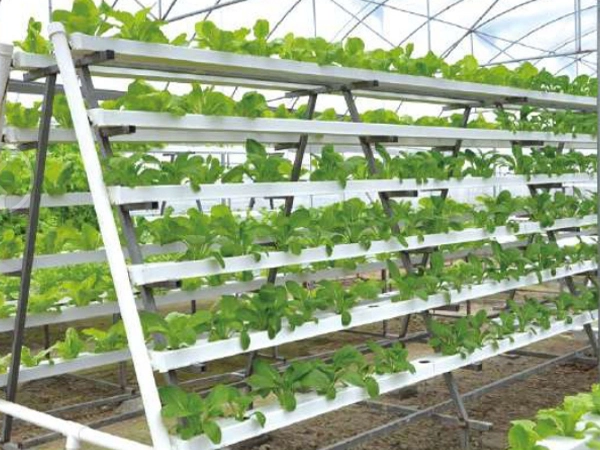
If a grower is building a lettuce-focused greenhouse, DWC tables, rafts, or NFT systems may provide better crop density and easier harvesting. China JY’s NFT Hydroponic System is also worth comparing for lettuce, herbs, and leafy vegetables because NFT channels can support clean layouts and efficient water flow.
If the grower is building a modular hydroponic project where centralized mixing, easy nutrient adjustment, and bucket-level access matter more than maximum plant density, RDWC can be a stronger option.
How to Choose a Supplier for DWC or RDWC Lettuce Systems
Choosing a DWC or RDWC supplier means checking whether the supplier understands crop density, water circulation, oxygen supply, material quality, and greenhouse operation. A reliable system should not only look complete; it should fit the crop, space, water source, labor plan, and commercial target.
Before ordering, buyers should confirm bucket or channel size, planting hole spacing, net pot size, pump flow, pipe diameter, air pump capacity, water level control, drainage design, food-safe material, UV resistance, spare parts, installation guidance, and packaging. For lettuce, growers should also plan seedling trays, transplanting workflow, harvest spacing, and cleaning between crop cycles.
China JY offers DWC, RDWC, NFT, Dutch bucket, aeroponics, ebb and flow, hydroponic fodder, greenhouse benches, fans, films, netting, and horticulture supplies. This broader product range helps buyers source not only the growing system, but also greenhouse accessories and cultivation tools needed for a complete lettuce production project.
Conclusion
DWC and RDWC are both useful hydroponic systems, but they serve different commercial lettuce needs. DWC is generally better for simple, high-density, lower-cost lettuce production. RDWC is better when growers need centralized water circulation, easier nutrient adjustment, and modular system control, but it requires more technical management and higher upfront investment.
For lettuce-focused commercial farms, buyers should compare DWC, RDWC, and NFT before finalizing system design. JY Grow Supply can support hydroponic system selection, greenhouse supply matching, and customized sourcing for growers, distributors, and commercial agriculture projects.
FAQ
1. What is the main difference between DWC and RDWC?
DWC keeps roots in an oxygenated nutrient reservoir, while RDWC connects multiple grow sites to a central reservoir and circulates nutrient solution through the system.
2. Is DWC good for commercial lettuce?
Yes. DWC is good for commercial lettuce because it is simple, stable, and suitable for leafy crops that grow well in oxygenated nutrient solution.
3. Is RDWC better than DWC for lettuce?
RDWC is better when growers need centralized nutrient control and modular circulation. However, for high-density lettuce, standard DWC or NFT may be more efficient and cost-effective.
4. What pH is best for hydroponic lettuce?
Hydroponic lettuce is commonly grown in a slightly acidic nutrient solution, often around pH 5.5 to 6.5 depending on cultivar, water quality, and nutrient formula.
5. What should buyers check before ordering a DWC or RDWC system?
Buyers should check bucket size, pump capacity, air supply, pipe layout, food-safe materials, planting density, drainage, water control, spare parts, and installation support.
6. Why choose China JY for DWC and RDWC systems?
China JY provides DWC hydroponic systems, hydroponic supplies, greenhouse supplies, NFT systems, net pots, Dutch buckets, and cultivation accessories for commercial growing and distribution projects.

 English